

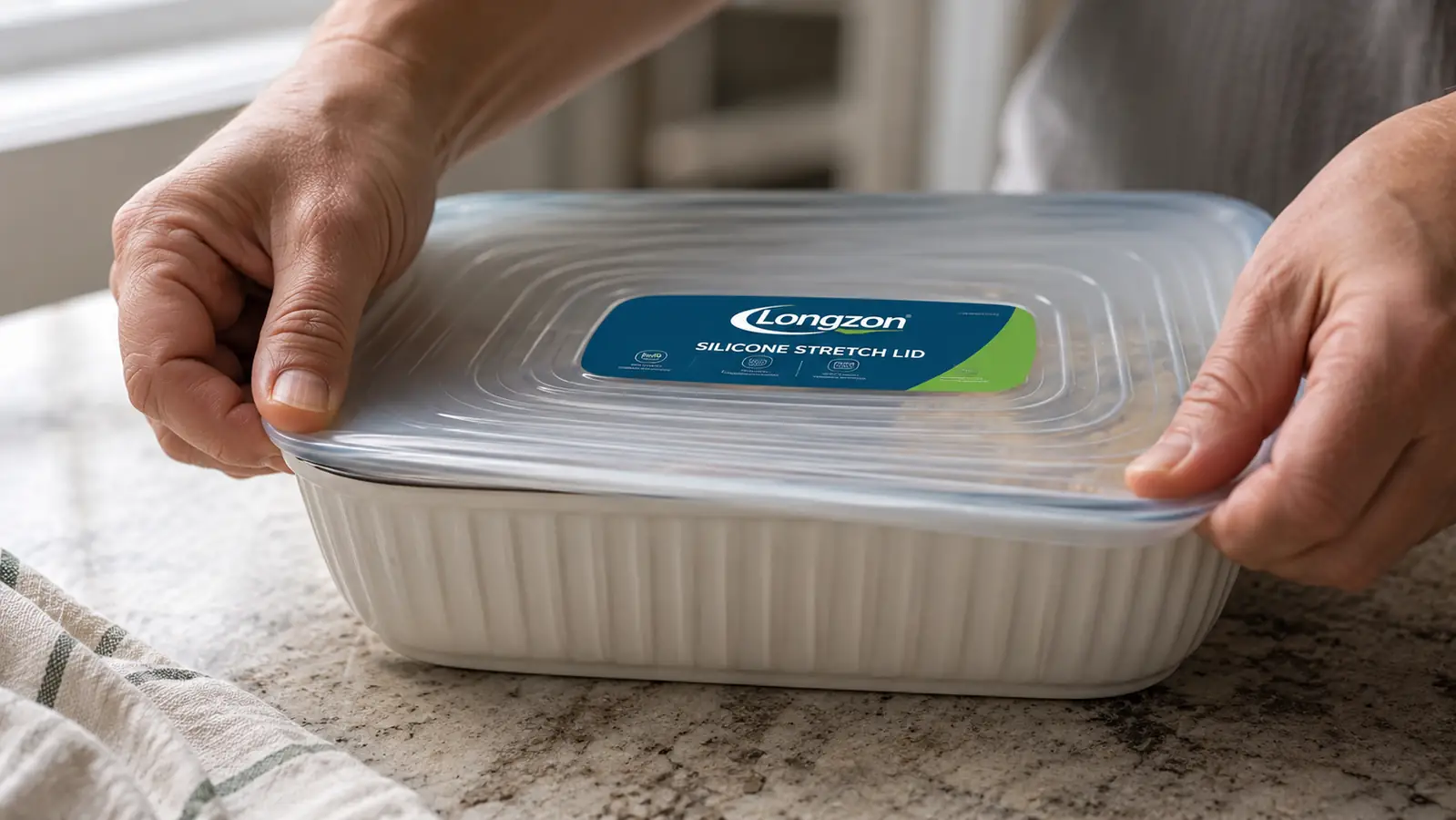
I bought the Longzon stretch lids on a Tuesday night after coming home from a twelve-hour shift to a sink full of mismatched Tupperware lids that didn't fit anything anymore. I had half a pot of soup, a bowl of cut cantaloupe, and a casserole dish with no lid at all, and I was too tired to hunt for plastic wrap. The 14-piece set showed up two days later, and the first thing I stretched one over was that same casserole dish, the rectangular one with no matching lid I'd been covering in foil for two years. It sealed flat across the top on the first try, no gaps at the corners, and I remember being almost annoyed that something this simple had taken me this long to buy.
I garden in central Texas on my days off, mostly tomatoes, cucumbers, bell peppers, and a zucchini plant that produces more than my family of four can eat in a season. Between the garden harvest and the meal prep I do for my twelve-hour shifts, I go through more bowls and containers in a week than most kitchens see in a month. This review is what actually happened to a $15.99 set of silicone stretch lids after six months of real, repeated, sometimes careless use, not a first-week unboxing.
The Quick Verdict
Six months in, most of the set still seals well and hasn't torn, but two of my most-used sizes have gone slightly loose and the largest lid struggles on anything but a perfectly round rim.
Amazon Check Today's Price →Stop rationing plastic wrap over bowls you use every single day.
If your fridge is full of half-covered leftovers and garden produce with nowhere to go, this 14-piece set replaces plastic wrap and foil for most of what you'll ever need to cover. Check today's price and current reviews on Amazon.
Amazon Check Today's Price on Amazon →How I've Used It
My test wasn't a lab, it was just my actual kitchen for six straight months. The set sits in the drawer directly under my stove, not tucked away somewhere I'd forget about, because if a tool isn't within arm's reach after a twelve-hour shift I won't bother digging for it. I've used at least one lid from the set nearly every single day since I opened the box, sometimes three or four in a single evening between leftovers, cut produce, and prepped ingredients for the next night's dinner.
I didn't treat this set gently. The Longzon lids have gone through the dishwasher's top rack more times than I've counted, they've covered hot soup straight off the stove, they've been stretched over bowls with jagged chipped rims, and they've sat in the fridge under the weight of stacked containers on nights when I was cramming the shelf full before a shift. If a silicone lid is going to stretch out, crack, or lose its seal, six months of that kind of treatment tends to show it.
What I paid attention to, loosely, was whether each size still formed a tight seal after repeated stretching, whether any lid tore or thinned at the edge, and whether food odors or tomato staining stuck around after washing. I also tracked which sizes I reached for constantly versus which ones sat unused, since a 14-piece set is only as good as the sizes you actually need in your own kitchen. I kept a running note on my phone for the first two months, just tally marks for which size I grabbed each night, before I trusted my own memory of the pattern.
The Design: Seven Sizes, Two of Each
The set comes with fourteen lids in seven sizes, two of each, ranging from small ones around 2.75 inches up to two extra-large lids at 9.8 inches across. The idea is that you stretch the silicone rim over the top of a bowl, jar, can, or dish, and the material's own tension pulls it snug against the surface, no separate lid or container needed. In practice I use five of the seven sizes on a regular basis, the smallest for covering a half-used lemon or a small jar of leftover salsa, a couple of the mid sizes for standard cereal bowls and coffee mugs, and the largest two for my big glass mixing bowl and that rectangular casserole dish I mentioned earlier.
The material itself is food-grade silicone, no plastic rim or hard edge anywhere, which was one of the reasons I picked this set over the rigid plastic stretch lids I'd tried years ago that cracked at the seam within a couple months. Each lid has a small tab molded into the edge that makes it easier to grip and pull when you're stretching it over a wide bowl, which matters more than it sounds like it should when your hands are still damp from washing dishes. The tab has held up on all fourteen lids, no tearing at that seam even on the two I use daily.
Where the design earns its keep is on odd shapes. Plastic wrap and rigid lids both assume a round opening, but my casserole dish is rectangular, my sourdough starter jar has a wide mouth with a chip in the rim, and my garden harvest often ends up in whatever bowl was clean, not whatever bowl matches a lid I own. The stretch and give in the silicone handles all of that without me having to think about it, which is really the whole selling point of the product. I've also used one of the mid-sized lids over an open soup can more than once, which is a small thing but it saves a dish.
Six Months In: What Held Up and What Didn't
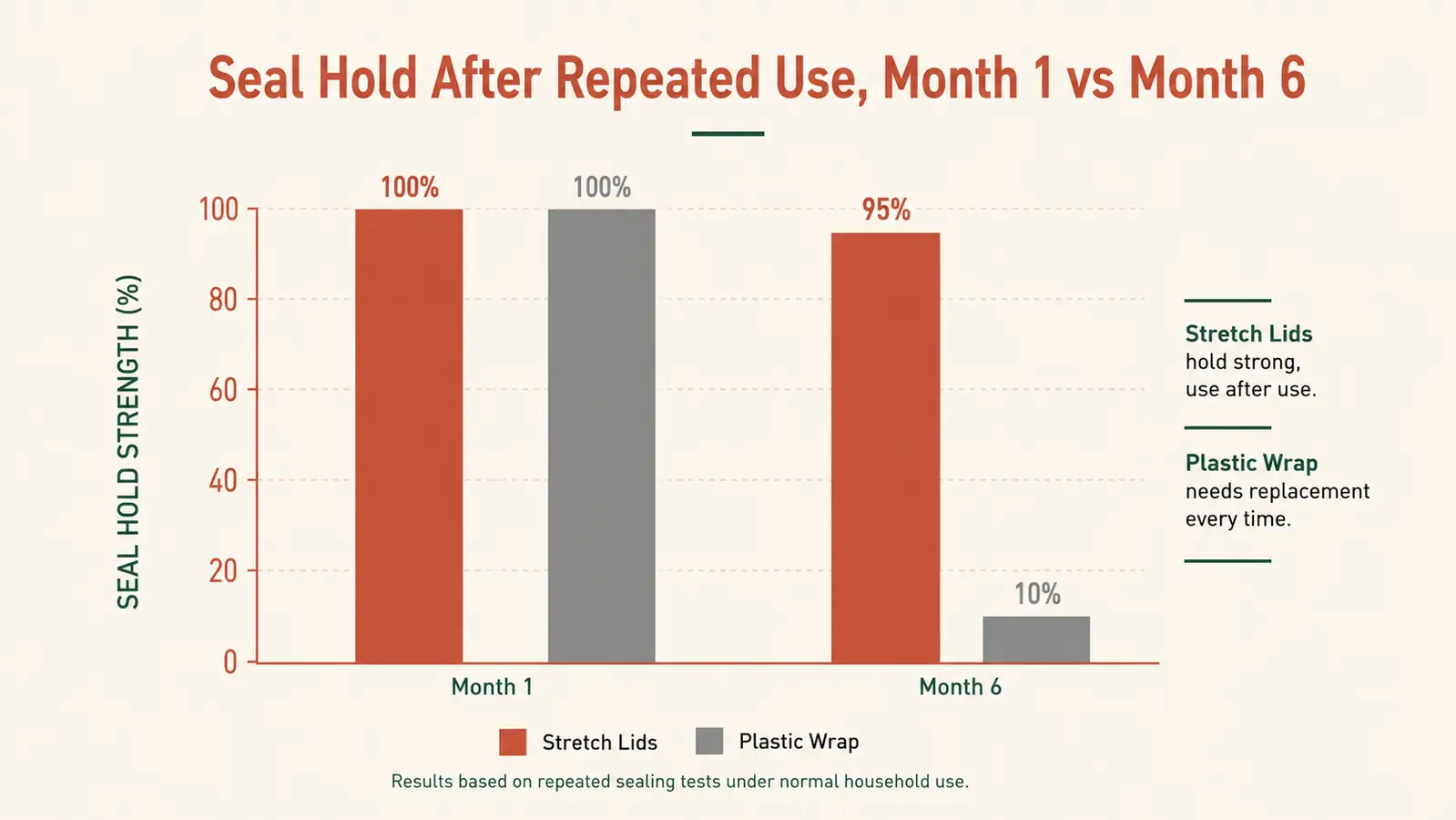
The honest news first: the two smallest sizes and the three mid sizes still perform exactly like they did on day one. No tearing, no thinning at the edges, and the seal is just as tight over a coffee mug or a small mixing bowl as it was the week I opened the box. Those five sizes get used almost daily in my kitchen and they've earned it. I'd guess I've stretched the smallest lid alone well over 150 times at this point, and it looks and behaves the same as it did in week one.
What hasn't held up as well are the two extra-large 9.8-inch lids. After roughly five months of near-daily stretching over my biggest mixing bowl, both of them have gone slightly loose at the rim. They still seal, but I have to smooth the edge down twice now instead of once, and on a very full bowl of cut garden tomatoes I've had the lid pop halfway off overnight if the bowl gets bumped in the fridge. That's the one real durability complaint I have after six months, and it tracks with what I've read in other long-term reviews of this style of lid, the largest sizes see the most stretch and the most wear.
Staining is the other honest note. Tomato sauce and turmeric-heavy dishes have left a faint orange tint on two of my lids that a regular dishwasher cycle hasn't fully removed. It doesn't affect the seal or the food safety, my dishwasher gets the Longzon lids clean enough to trust, but if you're picky about a lid looking brand new after six months, know that acidic sauces will leave a mark on light-colored silicone.
Garden Produce, Leftovers, and the Containers That Push It
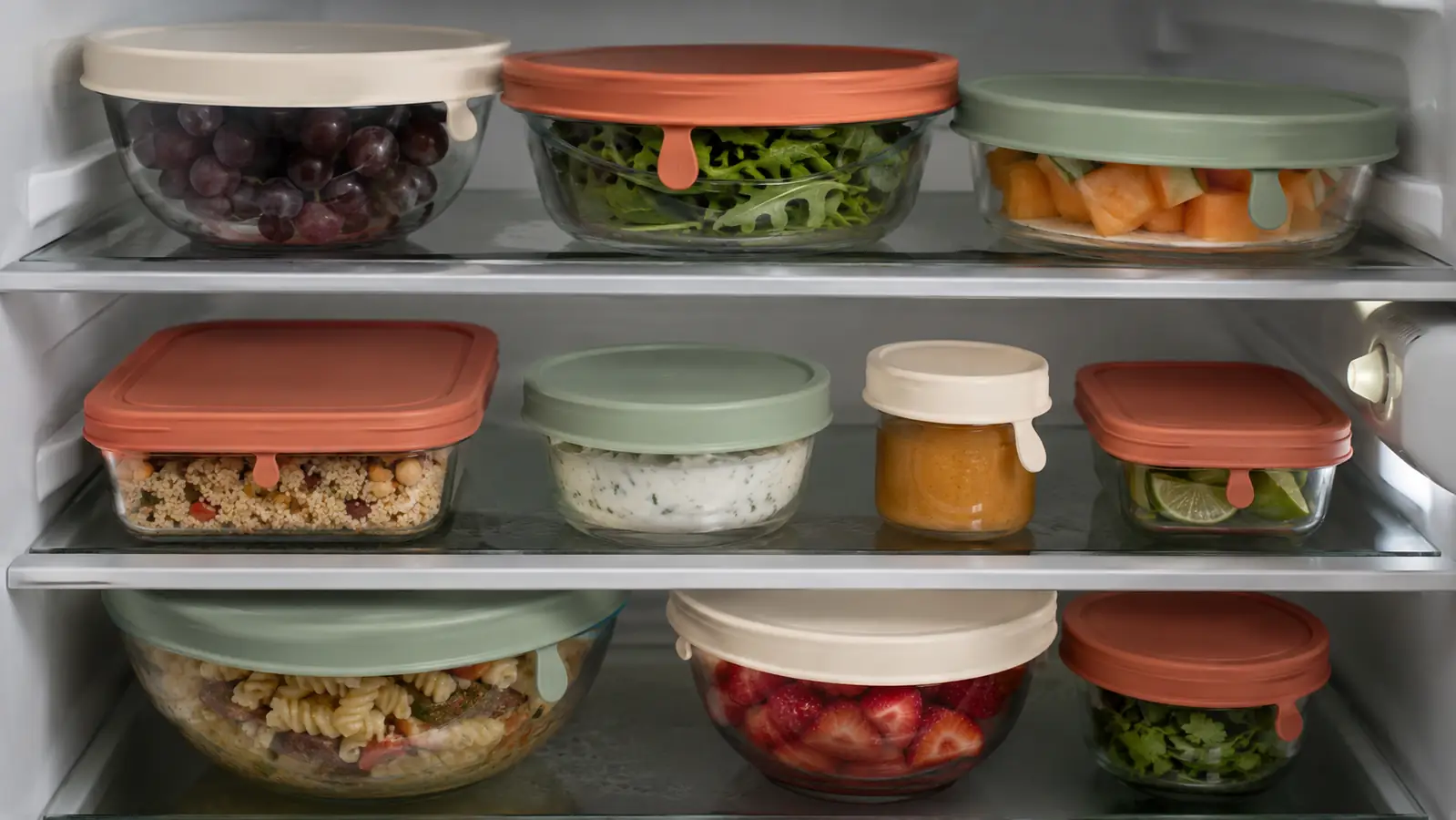
My garden is where this set gets used the hardest. During tomato season I'll harvest a full bowl most evenings, more cucumbers and bell peppers than I can process the same night, and the stretch lids let me cover whatever bowl I grabbed off the shelf without hunting for a matching container. A big glass bowl of just-picked tomatoes covered overnight, then uncovered the next evening to prep sauce, has been a near-weekly routine for six months straight.
Leftovers are the other half of the job. Half a casserole, a bowl of rice, cut cantaloupe or watermelon during the summer, all of it goes under one of these lids instead of a layer of plastic wrap I'd otherwise throw away after a single use. Over six months that's added up to a real dent in how much plastic wrap and foil I buy, which was honestly a bigger reason I kept using the set than I expected going in. I used to go through close to two rolls of plastic wrap a month, and I'm down to maybe half a roll now, mostly for wrapping sandwiches for my kids' lunches.
Where it gets pushed to its limit is on containers with an uneven or very wide rim. My biggest stockpot, the one I use for weekend chili batches, is wider than even the largest 9.8-inch lid can comfortably stretch to cover, so I still reach for foil there. And a couple of my older ceramic bowls have a slightly raised lip pattern around the edge that the silicone doesn't seat against perfectly, it seals well enough for the fridge but I wouldn't trust it for anything I'd want to tip sideways in a bag.
The Tradeoffs Nobody Mentions in the Five-Star Reviews
Most of what I read before buying made this sound like a lid for absolutely everything, and after six months I don't think that's the full picture. The largest two lids are genuinely the weak point of the set, they see more stretch than the smaller sizes because big bowls get used and reused daily in my kitchen, and by month five that repeated stretching had loosened both of them noticeably. If your household leans on large bowls constantly, expect the biggest sizes to wear faster than the rest.
It's also not a substitute for an airtight container if you're freezing something or need to transport food without any risk of a spill. I trust these lids completely in the fridge, but I still reach for a hard-sided container with a locking lid if I'm sending soup home with my mother or packing a bowl for a road trip. The stretch and seal is real, but it's a fridge-shelf solution, not a spill-proof one.
And the staining I mentioned earlier is worth repeating here, because it's the kind of thing that doesn't show up in a first-week review. Six months of tomato sauce, turmeric, and berry juice has left a couple of the lighter lids with a faint tint that soap and the dishwasher haven't fully lifted. It's cosmetic, not a hygiene issue, but if pristine-looking silicone matters to you, know that it happens. I've also noticed the smallest lid, the one I use most, is the first one I'll probably need to replace on its own well before the rest of the set wears out, just from sheer frequency of use.
What I Liked
- Seven sizes, two of each, cover everything from a small jar to a big mixing bowl
- Seals well on odd shapes, rectangular dishes, chipped rims, wide-mouth jars
- Five of the seven sizes still perform like day one after six months of near-daily use
- Dishwasher safe and holds up fine to repeated top-rack cycles
- Genuinely cut down how much plastic wrap and foil I buy each month
Where It Falls Short
- The two extra-large 9.8-inch lids have gone noticeably looser after about five months of daily stretching
- Acidic sauces and turmeric leave a faint stain on lighter-colored lids that washing doesn't fully remove
- Doesn't seat perfectly on bowls with a raised or uneven rim pattern
- Not a spill-proof solution for transporting food, still need a locking container for that
It's not flashy, it's just the thing I reach for before I reach for plastic wrap, six months in, even knowing the biggest two lids aren't quite as tight as they used to be.
Who This Is For
This set is built for people who go through bowls and containers constantly, gardeners like me bringing in tomatoes, cucumbers, and peppers more evenings than not, or anyone who cooks in batches on their days off and needs to cover whatever mismatched bowl is clean. If you're tired of digging through a drawer of lids that don't match anything you own, the range of sizes here solves that problem for the vast majority of what shows up in a home kitchen. It's also a solid pick for anyone trying to cut down on single-use plastic wrap without spending a lot of money to do it.
Who Should Skip It
If your household mostly needs to cover one or two large stockpots or wide serving dishes, you'll be leaning on the weakest part of this set, the two extra-large lids, and you may want to budget for a dedicated replacement sooner than six months. And if you regularly need to transport food without any risk of a spill, this isn't a substitute for a locking, hard-sided container, plan to keep a few of those around too. If you rarely cook in bulk or only ever cover the same single bowl size, a smaller two or three-piece set would probably serve you just as well for less money.
Six months of near-daily use later, this is still what covers my fridge shelf first.
If your kitchen sees garden produce, leftovers, and mismatched bowls more than once a week, this set earns its keep fast. See current pricing and stock on Amazon.
Amazon Check Today's Price on Amazon →